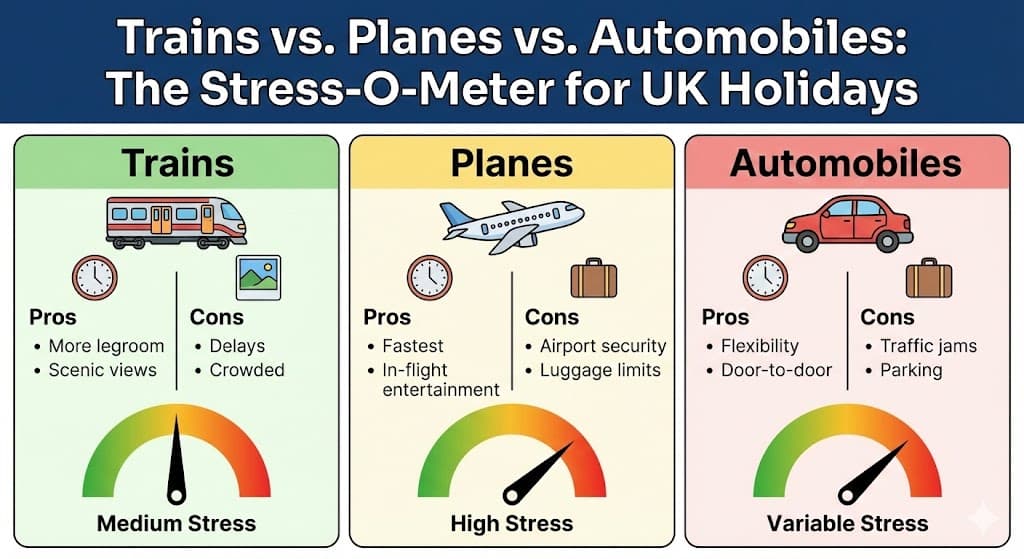
Trains vs. Planes vs. Automobiles: The Stress-O-Meter for UK Holidays
You need to get from A to B with children. Here's an honest comparison of every transport option—including the stress you don't see on the booking page.
Every family trip starts with the same question: how are we getting there?
On paper, it's simple. Check the distance, compare the prices, book the cheapest option. Done.
In reality, it's far more complicated. Because the ticket price doesn't include the stress of delayed trains with tired toddlers. Or the panic of motorway traffic when you're already late. Or the special kind of hell that is airport security with a family.
This is the guide the booking websites won't give you: an honest comparison of every major transport option for UK family holidays, rated not just on cost and time, but on the thing that actually matters—how much of your sanity survives the journey.
The Stress-O-Meter: How We're Rating
Every transport option gets rated on five factors:
- Cost – Total expense including hidden extras
- Time – Door-to-door, not just the advertised journey time
- Flexibility – What happens when things go wrong?
- Physical Demands – Luggage, walking, carrying, standing
- Child Tolerance – How well does this mode cope with children being... children?
We combine these into an overall Stress Score from 1 (zen) to 10 (why did we leave the house).
Option 1: The Car
Best for: Flexible day trips, destinations under 3 hours, families with lots of gear, babies and toddlers
The Real Costs
What you budget:
- Fuel (roughly 15-20p per mile for average family car)
- Maybe parking at destination
What you forget:
- Motorway service station "emergencies" (£15 for sandwiches and coffees)
- Wear and tear on the car
- Tolls (Dartford Crossing: £2.50, M6 Toll: up to £7.90)
- Parking at attractions (often £5-15)
Realistic total for a 100-mile day trip: £40-60 (fuel + parking + incidentals)
The Real Time
What the sat nav says: 2 hours 15 minutes
What actually happens:
- Leave 20 minutes late (someone needed the toilet, someone couldn't find their shoes)
- Traffic adds 30 minutes (it's half term, everyone's going the same place)
- Stop for petrol (10 minutes)
- Unscheduled "I feel sick" stop (15 minutes)
- Arrive: 3 hours 30 minutes after you planned to leave
Door-to-door reality: Add 50-75% to whatever Google Maps tells you during half term.
The Flexibility Factor
This is where cars win. Massively.
- Delays? Your problem, but at least you're in control
- Child meltdown? Pull over, deal with it, continue
- Plans change? Just... drive somewhere else
- Need to leave early? Leave early
- Too much stuff? It fits in the boot
No other transport mode comes close for flexibility.
The Physical Demands
- Luggage: Boot handles everything—pushchairs, bags, scooters, picnic supplies
- Walking: Minimal. Park, unload, you're there
- Standing: None (you're sitting the whole time)
- Carrying children: Only from car to destination
The Child Tolerance
Pros:
- Private space—meltdowns don't disturb strangers
- Snacks and entertainment on your terms
- Naps happen naturally in car seats
- Temperature control
- Toilet stops whenever needed
Cons:
- "Are we there yet?" times infinity
- Sibling fights in confined space
- Motion sickness risk
- You have to drive while parenting
The Stress Score: 5/10
Why it's not lower: Long drives are genuinely tiring. Traffic is unpredictable. You arrive already depleted.
Why it's not higher: Flexibility compensates for a lot. Problems are solvable. You're in control.
Best case: Smooth roads, sleeping children, arrive refreshed. 3/10
Worst case: Standstill traffic, screaming children, arrive frazzled and late. 8/10
Option 2: The Train
Best for: Cities with good stations, journeys of 1-3 hours, older children, day trips without heavy gear
The Real Costs
What you see:
- Advance tickets: Often surprisingly cheap (£15-40 for long distances if booked early)
- Anytime tickets: Eye-wateringly expensive (London to Manchester can be £100+)
What you forget:
- Getting to and from stations (taxi? bus? parking?)
- Food on trains (captive audience pricing)
- Seat reservations (essential with kids)
- The cost of missing your booked train if you're late
The family railcard calculation: A Family & Friends Railcard costs £30/year and gives 1/3 off adult fares and 60% off child fares. If you take more than 2-3 train trips a year, it pays for itself immediately. If you don't have one and you're planning a train holiday, buy it before you book.
Realistic cost comparison:
| Journey | Advance (family railcard) | Anytime | Driving equivalent |
|---|---|---|---|
| London to Bristol (2 adults, 2 kids) | £55-80 | £200+ | £50-70 |
| Manchester to Edinburgh (2+2) | £60-100 | £250+ | £80-100 |
| Birmingham to London (2+2) | £40-70 | £180+ | £40-60 |
Advance tickets compete with driving. Anytime tickets almost never do.
The Real Time
What the timetable says: 2 hours 10 minutes
What actually happens:
- Travel to station (20 minutes)
- Arrive early to guarantee seats (15 minutes)
- Boarding and settling (10 minutes)
- Journey (2 hours 10 minutes, but add 20 minutes for typical delays)
- Disembark and navigate station (10 minutes)
- Travel from station to destination (20 minutes)
Door-to-door reality: Double the advertised journey time for total trip planning.
The Flexibility Factor
The good:
- Delays are someone else's problem (you can claim refunds)
- You can walk around, go to the toilet, visit the buffet car
- Kids can play, read, look out window
The bad:
- Miss your advance ticket train = buy a new ticket at full price
- Cancellations leave you stranded
- You're dependent on connections working
- Getting a refund is administratively painful
The Physical Demands
- Luggage: You carry everything. Through stations. Up stairs. Onto platforms. Into overhead racks
- Walking: Potentially significant (large stations, platform changes)
- Standing: Possible if the train is full
- Pushchairs: Technically allowed, practically awkward—limited space, often have to fold
The Child Tolerance
Pros:
- Table seats are great for games, colouring, snacks
- Walking up and down the carriage burns energy
- Looking out the window is genuinely entertaining
- No one has to drive, so everyone can engage with children
Cons:
- Noise affects other passengers (stress for parents)
- Limited space for movement
- Toilets are grim and far away
- Meltdowns are public
The Stress Score: 6/10
Why it's not lower: The lack of flexibility is genuinely stressful with children. Missing a train or dealing with cancellations while managing kids is nightmare territory.
Why it's not higher: When it works, it's lovely. You can relax, interact with the kids, and arrive less tired than driving.
Best case: On-time train, table seats, kids entertained by scenery, arrive relaxed. 3/10
Worst case: Cancelled train, no seats, standing with pushchair, delayed connection, screaming toddler in quiet coach. 9/10
Option 3: The Coach
Best for: Budget-conscious families, longer distances, patient children, non-time-critical journeys
The Real Costs
Coaches are cheap. Genuinely cheap.
Sample National Express fares (booked in advance):
- London to Birmingham: £5-10 per person
- Manchester to London: £8-15 per person
- Bristol to Edinburgh: £20-30 per person
Family of four doing London to Manchester: potentially under £40 total.
What you forget:
- Time cost (see below)
- Food for longer journeys
- Entertainment to survive the duration
The Real Time
This is where coaches lose.
London to Manchester:
- Train: 2 hours 10 minutes
- Coach: 4 hours 30 minutes - 5 hours 30 minutes
London to Edinburgh:
- Train: 4 hours 20 minutes
- Coach: 8-10 hours
Coaches are slow. Factor in station-to-station time and you might spend all day travelling.
The Flexibility Factor
The good:
- Usually cheaper to change bookings than trains
- Frequent services on popular routes
- Luggage allowance is generous
The bad:
- Traffic affects coaches badly (no dedicated lanes)
- Missed coach = next one might be hours away
- Rest stops are scheduled, not on-demand
- No walking around
The Physical Demands
- Luggage: Stored underneath, but you still carry it to the coach
- Walking: Minimal once you're on
- Standing: Never (everyone has a seat)
- Pushchairs: Usually fold and go underneath
The Child Tolerance
Pros:
- Assigned seats (no fighting for space)
- Air conditioning
- Usually have toilets
- Very cheap means more budget for the destination
Cons:
- Cannot walk around
- Cannot easily access luggage
- Very long durations with restless children
- Rest stops are brief and at service stations
The Stress Score: 7/10
Why it's not lower: The duration is brutal with children. A 5-hour coach journey with kids is an endurance event.
Why it's not higher: It's cheap and predictable. You know what you're getting.
Best case: Quiet journey, kids sleep, arrive tired but solvent. 5/10
Worst case: Delays, traffic, no sleep, five hours of "I'm bored." 9/10
Option 4: The Plane
Best for: Long UK distances (London to Scotland), families who can travel light, children old enough to handle airports
The Real Costs
What you see: "Flights from £29!"
What you actually pay:
- Flights (often £50-100+ per person for reasonable times)
- Luggage (£20-40 per bag each way)
- Seat selection (£5-15 per person if you want to sit together)
- Airport parking (£50-100+ for a week)
- Or airport transfers (trains/taxis to airport)
- Food at airport (captive audience pricing)
- Travel from destination airport to actual destination
Realistic family cost (London to Edinburgh):
- Flights: £200-300
- Luggage: £80
- Parking: £80
- Airport extras: £40
- Total: £400-500
Same journey by train (advance, with railcard): £150-200
Same journey by car: £120-150
Flying within the UK rarely makes financial sense for families.
The Real Time
What the airline says: 1 hour 20 minutes
What actually happens:
- Travel to airport (1 hour)
- Arrive 2 hours before flight (security, check-in, gate finding)
- Security (20-40 minutes with family)
- Waiting at gate (30-60 minutes)
- Boarding (20 minutes)
- Flight (1 hour 20 minutes)
- Taxi to gate and disembark (20 minutes)
- Baggage reclaim (20-40 minutes)
- Travel from airport to destination (1 hour)
Door-to-door reality: 7-8 hours minimum for a "1 hour 20 minute" flight.
For domestic UK flights, this is almost always longer than driving.
The Flexibility Factor
The good:
- Fast once you're in the air
- Clear security/boarding process (you know what to expect)
The bad:
- Everything costs extra
- Delays cascade badly
- Cancelled flights are a nightmare
- Miss your flight = buy a new one
- Liquid restrictions mean no drinks/snacks through security
- Children's items (car seats, pushchairs) require special handling
The Physical Demands
- Luggage: Restricted, expensive, and you carry it far
- Walking: Enormous amounts. Airports are huge
- Standing: Lots—queues everywhere
- Pushchairs: Gate-checked, returned at destination, often handled roughly
The Child Tolerance
Pros:
- Kids often enjoy planes (novelty factor)
- Short actual flight time
- Some airlines provide kids' activity packs
Cons:
- Ear pressure during takeoff/landing (pain for young children)
- Security is stressful with kids
- Long waits in airports with limited entertainment
- Very restricted movement
- No tolerance for meltdowns in confined space
- Liquids ban means no milk bottles through security
The Stress Score: 8/10
Why it's not lower: Airports with children are objectively terrible. The security process, the queues, the waiting, the confined spaces, the potential for disasters at every stage.
Why it's not higher: If the destination is far enough, or you're going abroad, there's no alternative.
Best case: No queues, on-time flight, kids excited by planes, luggage arrives. 5/10
Worst case: Delayed flight, missed connection, lost luggage, meltdown in security queue, everyone crying including you. 10/10
Option 5: The Ferry
Best for: Holidays involving vehicles, journeys where the ferry is part of the experience, families who don't mind slower travel
When It's Relevant
UK internal ferries worth considering:
- Isle of Wight (Southampton/Portsmouth)
- Scottish islands (CalMac routes)
- Isles of Scilly
- Various Welsh/English coastal connections
Channel crossings for French holidays:
- Dover to Calais
- Portsmouth to various French ports
The Real Costs
Varies enormously by route and season. Isle of Wight foot passenger return can be £25-40. Car + passengers might be £80-150.
Channel crossings: £100-300+ for car and family, depending on timing.
The Real Time
What they advertise: Crossing time only
What you experience: Check-in + loading + crossing + unloading + driving off
Dover-Calais "90 minutes" is really 3 hours door-to-door from port to port.
The Flexibility Factor
The good:
- Usually relaxed about booking changes
- Miss your ferry = next one (often)
- Break in the journey can be welcome
The bad:
- Weather delays
- Limited sailing times
- Need to arrive early
- Vehicle queuing can take ages
The Child Tolerance
Pros:
- Freedom to walk around
- Often have play areas, restaurants, shops
- Fresh air on deck
- Sea is genuinely interesting
Cons:
- Potential for seasickness
- Need to manage children in large, busy space
- Announcements about returning to vehicle can be stressful
- Weather can make deck time miserable
The Stress Score: 5/10
Why it's not lower: Weather uncertainty, potential for sickness, managing kids in busy public space.
Why it's not higher: Fundamentally quite relaxed. Walking around, seeing the sea, having a break from driving.
Best case: Calm crossing, kids explore happily, arrives feeling like part of the holiday. 3/10
Worst case: Rough seas, sick children, long vehicle queues, missed connection. 8/10
The Comparison Table
| Mode | Cost (family of 4, medium journey) | Door-to-Door Time | Flexibility | Stress Score |
|---|---|---|---|---|
| Car | £40-70 | Predictable + traffic | Excellent | 5/10 |
| Train (advance) | £50-100 | 2x advertised | Poor | 6/10 |
| Coach | £30-50 | Very long | Medium | 7/10 |
| Plane | £300-500 | 6-8 hours minimum | Very poor | 8/10 |
| Ferry | Route dependent | Crossing + buffers | Medium | 5/10 |
The Decision Framework
Choose the CAR if:
- Journey is under 3 hours
- You have lots of stuff
- You have a baby or toddler
- Flexibility is important
- The destination has free/cheap parking
Choose the TRAIN if:
- Journey is 1-3 hours
- You're going city centre to city centre
- You can book advance tickets
- You have older, patient children
- You want to avoid driving fatigue
Choose the COACH if:
- Budget is the primary constraint
- Time is not the primary constraint
- Children are old enough to cope with long durations
- You're travelling to a destination poorly served by trains
Choose to FLY if:
- You're going abroad
- Domestic journey is 5+ hours by other modes
- You can genuinely travel light
- You've done the real cost calculation and it still works
Choose the FERRY if:
- You're going somewhere that requires one
- You want the journey to be part of the experience
- You have time to spare
Our Recommendation for Half-Term Day Trips
For typical half-term outings—a day at a zoo, a beach trip, a city visit—the car wins for most families.
The flexibility is unbeatable. The ability to handle children, stuff, and emergencies in a private space matters. The stress of public transport with children often outweighs the stress of driving.
Exceptions:
- Central London (don't drive into London, it's not worth it)
- Long day trips where you'd arrive exhausted from driving
- Families who genuinely don't own a car
For those exceptions, trains with advance tickets and a Family Railcard are the next best option.
Let Us Handle What Happens When You Arrive
However you get there, we'll make sure the day itself is planned.
The School Holiday Planner generates itineraries based on your location and budget—including realistic timing for activities, backup plans, and practical information like parking and booking requirements.
You handle the transport. We'll handle the destination.
How do you prefer to travel with your family? Any tips we've missed? Let us know what works (and what definitely doesn't) for your lot.