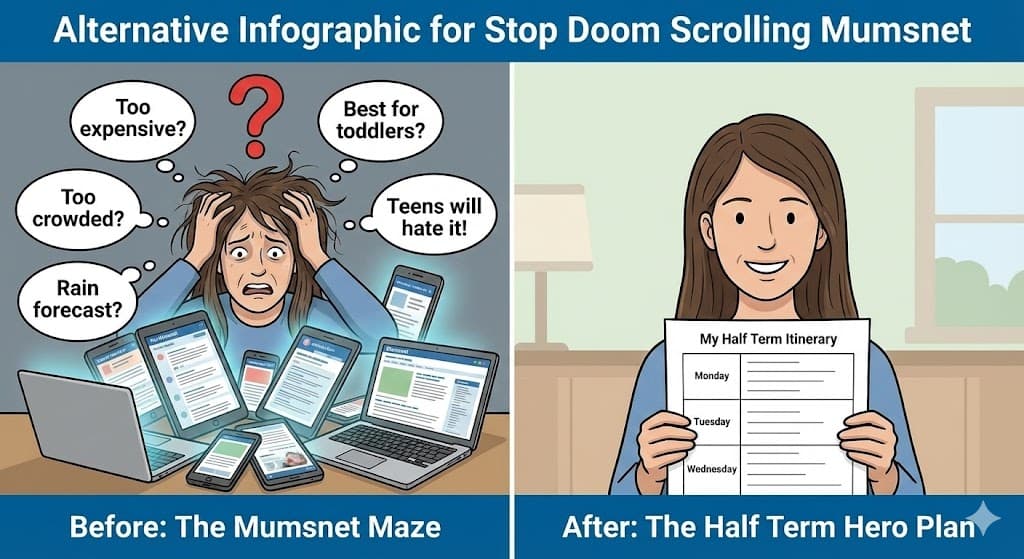
Stop "Doom Scrolling" Mumsnet: Why You Need a Single Itinerary
You've got 47 browser tabs open, three conflicting recommendations, and you still don't know what you're doing on Tuesday. There's a better way.
It's 10:47pm on a Sunday. Half term starts tomorrow.
You're sitting in bed with your phone, supposedly "just quickly planning the week." That was two hours ago.
Since then, you've:
- Scrolled through 200 Mumsnet threads about "things to do in [your area]"
- Opened seventeen attraction websites in different tabs
- Compared soft play prices across four venues
- Read a Reddit thread about whether a particular farm is "worth it"
- Googled "free things to do half term 2025" and clicked on seven listicles
- Discovered a place that looks perfect, only to find it's fully booked
- Started again
You now have more options than when you started, less clarity, and a growing sense of dread about the week ahead.
This isn't planning. This is doom scrolling with a purpose.
And it's making everything worse.
The Paradox of Choice (And Why Your Brain Hates Half Term)
In 2000, psychologists Sheena Iyengar and Mark Lepper ran a now-famous experiment in a California supermarket. They set up a tasting booth with jam samples. Some days, they offered 24 varieties. Other days, just 6.
The results were striking:
- The 24-jam display attracted more people initially
- But the 6-jam display resulted in ten times more purchases
When faced with too many options, people froze. They couldn't decide, so they decided nothing.
This is the paradox of choice: more options don't make us happier—they make us anxious, overwhelmed, and less likely to act.
Now apply this to half term planning.
Your "jam display" looks something like:
- Hundreds of attractions within driving distance
- Thousands of Mumsnet recommendations
- Dozens of "best days out" listicles
- Multiple weather scenarios to account for
- Different ages to cater for
- A budget to stick to
- Various opening times, booking requirements, and pricing structures
This isn't 24 jams. This is 24,000 jams. And your brain is doing exactly what those supermarket shoppers did: freezing.
The Real Cost of "Research Mode"
Let's be honest about what happens when you try to plan half term by browsing:
The Time Cost
That "quick half hour" of planning never stays half an hour. You fall into research rabbit holes. You compare options endlessly. You read reviews, check Instagram, look at photos.
A 2019 study by the American Psychological Association found that the average person spends over 2 hours per day just deciding things—and that's before you add the cognitive load of planning a family holiday.
Two hours of research, repeated across multiple evenings, across multiple holidays per year. That's time you don't get back.
The Energy Cost
Decision fatigue is real. Every choice you make depletes your mental energy. By the time you've compared seven soft play centres, you're too exhausted to actually decide—so you either pick randomly, defer the decision to tomorrow, or give up entirely.
This is why you end up lying awake at 11pm still not knowing what you're doing on Wednesday.
The Anxiety Cost
Here's the cruel irony: the more research you do, the more anxious you become.
Because you've seen so many options, you know what you're missing. You've read the glowing review of that place you can't afford. You've seen the photos of that attraction that's too far away. You've discovered the perfect venue that's fully booked.
Every option you don't choose becomes a small regret. Every decision feels like a trade-off.
Psychologist Barry Schwartz calls this "anticipated regret"—the fear of making the wrong choice, amplified by knowing exactly what you're giving up.
The Relationship Cost
How many arguments start with "I thought YOU were sorting it"?
When planning is distributed across browser tabs, Mumsnet threads, and half-remembered conversations, nobody knows who's responsible for what. Things fall through the cracks. Assumptions don't match. Someone ends up resentful.
The Problem With Crowdsourced Advice
"Just ask on Mumsnet" is the default recommendation for UK parents. And yes, Mumsnet is genuinely useful for many things.
But for half term planning, crowdsourced advice has some fundamental problems:
1. It's Not Personalised
When someone asks "what should we do in Leeds this half term?" they get:
- Recommendations from people with different aged kids
- Suggestions at every price point
- Options for people with cars and without
- Ideas that suit different interests
You then have to mentally filter every single response against your own circumstances. That's work. That's cognitive load.
2. It's Often Outdated
That amazing soft play recommendation from 2019? It might have closed. Changed ownership. Doubled its prices. Lost its car park.
Forum threads persist long after the information in them has expired.
3. It's Overwhelming By Design
A good Mumsnet thread generates dozens of responses. That's the point—more voices, more ideas.
But you don't need dozens of ideas. You need one plan. The volume of responses actively works against decision-making.
4. It Doesn't Account for the Full Picture
Mumsnet can tell you that Tropical World in Leeds is great. It can't tell you:
- Whether it fits your budget for the week
- What to do if it rains on the way there
- What to pair it with on the same day
- How it fits into a balanced week of activities
You have to hold all of that in your head, across all the recommendations, and synthesise it yourself.
What You Actually Need
Let's step back from the tactics and think about what good half term planning actually requires:
You need answers to these questions:
- What are we doing each day?
- How much will it cost in total?
- What's the backup if weather/illness/chaos intervenes?
- Is there a good mix of activities across the week?
- Have we remembered to book what needs booking?
That's it. Five questions.
The problem with doom scrolling is that it generates infinite options without answering these questions. You end up with a list of possibilities, not a plan.
What you actually need is:
- A single document
- That covers every day
- With costs calculated
- And backups included
- That you can just... follow
Not more options. Fewer options. One option. The right option.
The Relief of "Done"
There's a specific feeling when half term planning clicks into place. When you close all the tabs. When you stop scrolling. When you know what you're doing.
It's not excitement, exactly. It's relief.
Relief that you don't have to think about it anymore. Relief that the decisions are made. Relief that tomorrow has an answer.
This feeling is what psychologists call "cognitive closure"—the mental satisfaction of completing a task and moving on.
Doom scrolling never gives you this. There's always one more thread to read, one more option to consider, one more review to check. The task is never complete, so the relief never comes.
A single itinerary, by contrast, is done. It exists. You can print it, share it, stick it on the fridge. The question "what are we doing this half term?" has an answer.
That answer might not be perfect. It might not include every single attraction you saw while scrolling. But it's done. And done beats perfect every single time.
The Case for Constraints
Here's a counterintuitive truth: constraints make us happier.
When someone else makes decisions for us—within sensible boundaries—we feel liberated, not restricted.
This is why:
- Package holidays are still popular (despite being "less flexible")
- Meal kit services are booming (even though you could buy the ingredients yourself)
- People pay for personal trainers (who just tell them what to do)
In each case, people are paying for the removal of decisions. The value isn't the content—it's the curation.
A half term itinerary works the same way. When someone says "Monday: park. Tuesday: museum. Wednesday: home day. Thursday: farm. Friday: swimming"—you're not being limited. You're being freed.
Freed from the scroll. Freed from the comparison. Freed from the 11pm anxiety.
What Good Looks Like
Imagine this instead:
It's Sunday evening. You open a single document—maybe a PDF on your phone, maybe a page you've saved.
It says:
Monday 17th February
- Main: Roundhay Park (free, pack a picnic)
- Backup if wet: Leeds City Museum (free)
- Evening wind-down: Cardboard box crafts
Tuesday 18th February
- Main: Yorkshire Wildlife Park (pre-booked, £56 family ticket)
- Backup if wet: Go anyway—most enclosures have covered areas
- Evening wind-down: Animal drawing
Wednesday 19th February
- Main: Home day—baking and garden play
- Backup: Not needed (we're home)
- Evening wind-down: Movie night
And so on for the rest of the week.
Total cost: calculated. Bookings: done. Weather contingencies: covered. Mix of free and paid: balanced. Mix of active and calm: balanced.
You read it once. You know what you're doing. You close the document.
That's it. That's the feeling.
"But What If I Don't Like the Plan?"
This is the fear that keeps people scrolling: what if someone else's plan doesn't match what I want?
Here's the thing: you can always change it. A plan isn't a contract. It's a starting point.
Having a plan you modify is infinitely better than having no plan at all. You can swap Tuesday and Thursday. You can replace the farm with the aquarium. You can skip Wednesday's activity if everyone's tired.
But you're modifying from a position of clarity, not building from a position of chaos.
The plan gives you something to react to. The scroll gives you nothing but more options.
How We Built a Solution
This is why we created the School Holiday Planner.
Not another list of options. Not a forum to scroll through. A tool that generates one plan—your plan—based on what you actually tell us.
You input:
- Your kids' ages
- Your location
- Your dates
- Your budget
- Whether you have a car
- Any specific interests
We output:
- A day-by-day itinerary
- A backup activity for every outdoor day
- An at-home idea for every evening
- A running cost total
- A packing list
- Booking reminders
One document. One plan. Done.
You can generate it in 60 seconds. You can save it, print it, share it with your partner. You can regenerate it if you want different options.
But you never have to scroll through Mumsnet at 11pm again.
The Maths of Your Time
Let's do a quick calculation:
The "research" approach:
- 2+ hours of scrolling and comparing
- Repeated across multiple evenings
- Plus decision anxiety throughout
- Plus the cost of things you forgot to book
- Plus the arguments about who was responsible for what
The "single itinerary" approach:
- 60 seconds to input your details
- 30 seconds to review the plan
- Done
Even if our tool cost money (the first plan is free), the time saving alone would be worth it. An hour of your evening is worth something. Several hours across a week is worth a lot.
But more than the time, it's the headspace. The freedom from the scroll. The closure of having a plan.
That's worth more than any of us like to admit.
Try It Now
Half term is coming. You can spend tonight scrolling, comparing, and stressing.
Or you can spend 60 seconds telling us about your family and get a complete plan generated instantly.
One itinerary. Every day covered. Backups included. Budget tracked.
The relief of "done."
Still prefer to plan manually? That's okay too. But if you've read this far, you probably recognise the scroll. You probably know the feeling. Maybe it's time to try something different.