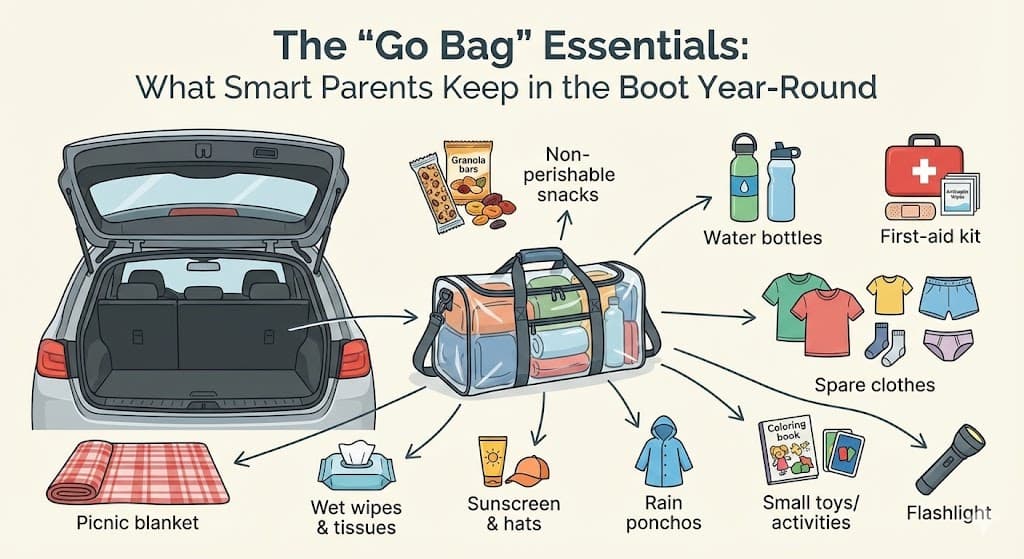
The "Go Bag" Essentials: What Smart Parents Keep in the Boot Year-Round
The difference between "let's go to the beach!" and "we can't, we don't have anything" is one well-stocked bag in the car.
There are two types of families.
Family A: It's a sunny Saturday afternoon. Someone suggests going to the park, or the beach, or that farm they've been meaning to visit. What follows is 45 minutes of packing, three trips back into the house for forgotten items, and at least one argument about whether anyone knows where the sun cream is.
By the time they leave, the enthusiasm has evaporated. They arrive late, stressed, and missing at least one essential item.
Family B: Same sunny Saturday. Same suggestion. They grab jackets, get in the car, and go. Everything else they need is already in the boot. They arrive on time, relaxed, and fully equipped.
The difference isn't organisation skills or personality type. It's one bag. In the car. Always.
This is the guide to building that bag—the "go bag" that turns spontaneous plans into actual outings, and planned trips into stress-free departures.
The Philosophy: Why This Works
The go bag works because of one simple principle: every trip shares the same basic needs.
Whether you're going to a beach, a park, a museum, or a grandparent's house, you need:
- Weather protection
- Spare clothes for accidents
- Basic first aid
- Snacks and drinks
- Entertainment backup
- Clean-up supplies
The specific venue might need specific additions (swimming stuff for the pool, wellies for the farm), but the core needs are constant.
By keeping that core in the car permanently, you eliminate 80% of the packing stress for 100% of your trips.
The Master List: Everything in the Go Bag
Section 1: Spare Clothes
For each child:
- Full change of clothes (top, bottom, underwear, socks)
- Sealed in a large ziplock bag (keeps them clean and dry)
- Appropriate for the current season (rotate when seasons change)
Why it matters: Children get wet, muddy, sick, or have accidents. A spare outfit means the day continues. No spare outfit means going home.
Pro tip: Include one outfit larger than their current size. Kids grow, and you'll forget to update the bag.
Additional items:
- Spare adult t-shirt (you will get things on you)
- Spare socks for everyone (wet socks ruin everything)
Section 2: Weather Protection
Year-round:
- Packable rain jacket for each family member
- Sun cream (SPF 30+, in-date, check expiry quarterly)
- Sun hats (packable/crushable)
- Small umbrella
Seasonal additions:
- Summer: Extra sun cream, after-sun, sunglasses
- Winter: Gloves, warm hats, hand warmers
- Spring/Autumn: Layers, extra jackets
Why it matters: British weather changes. The forecast lies. Being prepared for sun AND rain means you can go ahead with plans regardless.
Pro tip: The packable rain jackets from Uniqlo, Decathlon, or similar compress to nothing and live permanently in the bag. No excuses.
Section 3: First Aid & Health
The basics:
- Plasters (multiple sizes, include some waterproof)
- Antiseptic wipes
- Antihistamine (Piriton or similar—check dosage for your children)
- Insect bite cream
- Paracetamol and ibuprofen (child and adult versions)
- Tweezers (for splinters)
- Nail clippers (hangnails cause meltdowns)
- Any prescription medications your family needs
The extras:
- Sick bags (5-10, the fold-flat kind, or dog poo bags)
- Rehydration sachets (for stomach bugs or hot days)
- Lip balm with SPF
- Mini hand sanitiser
For specific needs:
- EpiPen (if anyone has allergies)
- Inhaler (if anyone has asthma)
- Any other condition-specific medication
Why it matters: Small injuries happen on every outing. Being able to patch up a grazed knee and continue the day is worth the weight of a small first aid kit.
Pro tip: Check medications quarterly for expiry dates. Set a calendar reminder.
Section 4: Snacks & Drinks
The permanent stash (non-perishable, rotate monthly):
- Cereal bars or granola bars
- Rice cakes or crackers
- Dried fruit (raisins, apricots)
- Small bags of nuts (if no allergies)
- Plain biscuits (rich tea, digestives)
The drinks setup:
- Reusable water bottles (one per family member, kept filled)
- Squash concentrate (small bottle, for flavouring water)
- Emergency juice boxes (2-3, sealed)
Why it matters: Hungry children are nightmare children. Having emergency snacks prevents the 4pm meltdown and the expensive "we have to find a café NOW" detour.
What NOT to include:
- Chocolate (melts)
- Crisps in crushable bags (become crumbs)
- Anything that smells strongly (car will smell)
- Perishables (unless you're adding them for a specific trip)
Pro tip: The snack box isn't for regular consumption—it's emergency backup. If you eat from it, replace immediately.
Section 5: Clean-Up Supplies
Essentials:
- Baby wipes (even if you don't have a baby—they clean everything)
- Kitchen roll (full roll)
- Hand sanitiser (full-size bottle)
- Carrier bags (5-10, for rubbish, wet clothes, sick disposal)
- Old towel (for wet children, muddy dogs, beach sand)
Optional but excellent:
- Portable stain remover pen
- Disposable gloves (for the really bad situations)
- Car bin (small container that lives in the footwell)
Why it matters: Mess happens. Being able to clean it up immediately means you can continue with your day instead of sitting in filth or cutting things short.
Pro tip: The old towel is one of the most useful items. It handles wet swimming costumes, muddy boots, sandy feet, sick situations, and general mess.
Section 6: Entertainment Backup
Physical items:
- Small bag of "car toys" (2-3 small toys per child, rotate monthly)
- Colouring book and crayons (for cafés, restaurants, waiting)
- Pack of cards
- Small notepad and pen
- A book each
Digital backup:
- Portable phone charger (charged)
- Charging cables for all devices
- Headphones (wired—no battery to die)
- Downloaded content on tablets (check before trips)
Why it matters: Waiting happens. Queues, delays, restaurant service, traffic. Having entertainment ready prevents boredom spiralling into chaos.
Pro tip: The "car toys" should be different from home toys. The novelty makes them more engaging.
Section 7: Practical Tools
Essential:
- Cash (£20-30 in notes and coins—ice cream vans, parking machines, places with no card)
- Torch (small, LED, check batteries work)
- Reusable shopping bag (for unexpected purchases or carrying things)
- Tissues (travel pack)
- Sunglasses (for driver—safety, not fashion)
Useful:
- Phone emergency charger
- Pen and paper (for leaving notes, writing down info)
- Scissors (small, blunt-ended)
- Duct tape (small roll—fixes everything temporarily)
- Cable ties (surprisingly useful)
Car-specific:
- Ice scraper (winter)
- Blanket (emergencies, picnics, cold children)
- Hi-vis vest (if you break down)
- Tyre inflator or repair kit (check if your car has a spare)
Why it matters: These are the "I wish I had..." items. Every parent has been caught without cash at an ice cream van, without a torch at dusk, without a bag when hands are full.
The Physical Setup: How to Organise It
Option 1: The Single Bag Method
Best for: Smaller cars, minimalists, families who want to grab-and-go.
One large holdall or backpack contains everything. Lives in the boot. Grab the whole bag when you leave the car, or access individual items as needed.
Pros: Simple, portable, easy to manage.
Cons: Can get heavy, harder to find specific items.
Option 2: The Box System
Best for: Larger boots, families who want categories, people who like organisation.
Use a car boot organiser or several smaller boxes:
- Box 1: First aid and health
- Box 2: Snacks and drinks
- Box 3: Clothes and weather gear
- Box 4: Entertainment and miscellaneous
Pros: Easy to find things, can take specific boxes for specific trips.
Cons: Takes up more space, more to manage.
Option 3: The Hybrid Method
Best for: Most families—practical balance.
One main bag with the essentials (first aid, snacks, clean-up, basic entertainment). Separate items stored loose in the boot:
- Picnic blanket
- Wellies
- Folding chairs
- Beach bag (seasonal)
Pros: Core bag is portable, extras are accessible when needed.
Cons: Requires more boot space.
The Seasonal Rotation
The go bag isn't static. Rotate contents quarterly:
Spring (March)
- Add: Lighter rain jackets, sun cream (new bottle), sunglasses
- Remove: Heavy winter gear, hand warmers
- Check: All expiry dates, battery levels, snack freshness
Summer (June)
- Add: Extra sun cream, after-sun, more water bottles, beach towel, sun tent/shade
- Remove: Warm layers (keep one light jacket)
- Check: Sun cream expiry, restock snacks
Autumn (September)
- Add: Warmer layers, waterproof trousers, extra socks
- Remove: Beach gear (unless you're hardy)
- Check: Torch batteries, medication expiry
Winter (December)
- Add: Gloves, hats, hand warmers, ice scraper, emergency blanket
- Remove: Summer sun gear (keep basic sun cream—winter sun exists)
- Check: Everything—winter breakdowns are serious
Pro tip: Set four calendar reminders a year for rotation. Takes 15 minutes, prevents disasters.
The Quick Reference Checklist
Print this. Stick it inside a kitchen cupboard. Check it quarterly.
Go Bag Core Contents
Clothes: □ Spare outfit per child (ziplock bag) □ Spare socks for everyone □ Spare adult t-shirt
Weather: □ Rain jacket per person □ Sun cream (in-date) □ Sun hats □ Umbrella
First Aid: □ Plasters (various sizes) □ Antiseptic wipes □ Antihistamine □ Pain relief (child + adult) □ Sick bags □ Personal medications
Snacks: □ Cereal/granola bars □ Crackers/rice cakes □ Dried fruit □ Water bottles (filled) □ Emergency juice boxes
Clean-up: □ Baby wipes □ Kitchen roll □ Hand sanitiser □ Carrier bags □ Old towel
Entertainment: □ Small toys (2-3 per child) □ Colouring book + crayons □ Cards □ Phone charger + cables □ Headphones
Practical: □ Cash (£20-30) □ Torch □ Reusable bag □ Tissues □ Pen + paper
Seasonal items updated: □
The Spontaneity Payoff
Here's what the go bag actually gives you: the ability to say yes.
"Can we go to the park?" Yes. "The weather's nice—beach?" Yes. "Let's visit grandma this afternoon." Yes. "That farm looks good, should we go tomorrow?" Yes.
Every "yes" that becomes possible because you're always ready is a memory your kids will have. Every "no, we're not prepared" is a missed opportunity.
The half term families who have the best time aren't the ones with the most money or the most elaborate plans. They're the ones who can pivot, who can be spontaneous, who can say "let's just go."
The go bag makes that possible.
The Day Trip Connection
The go bag handles the basics. But knowing where to go? That's a different challenge.
The School Holiday Planner generates day-by-day itineraries based on your location, your kids' ages, and your budget. We handle the destination planning—you just grab your go bag and drive.
Spontaneity works best when you've got both parts: the supplies to go anywhere, and the ideas for where to go.
Get your half-term destination ideas
The Printable Checklist
Want a version you can print and stick in the car?
We've made a free PDF checklist of everything in this guide—organised by category, with tick boxes for quarterly checks.
Download the free Go Bag checklist
What's in your car go bag that we've missed? Every family has their own essentials—let us know what you can't travel without.