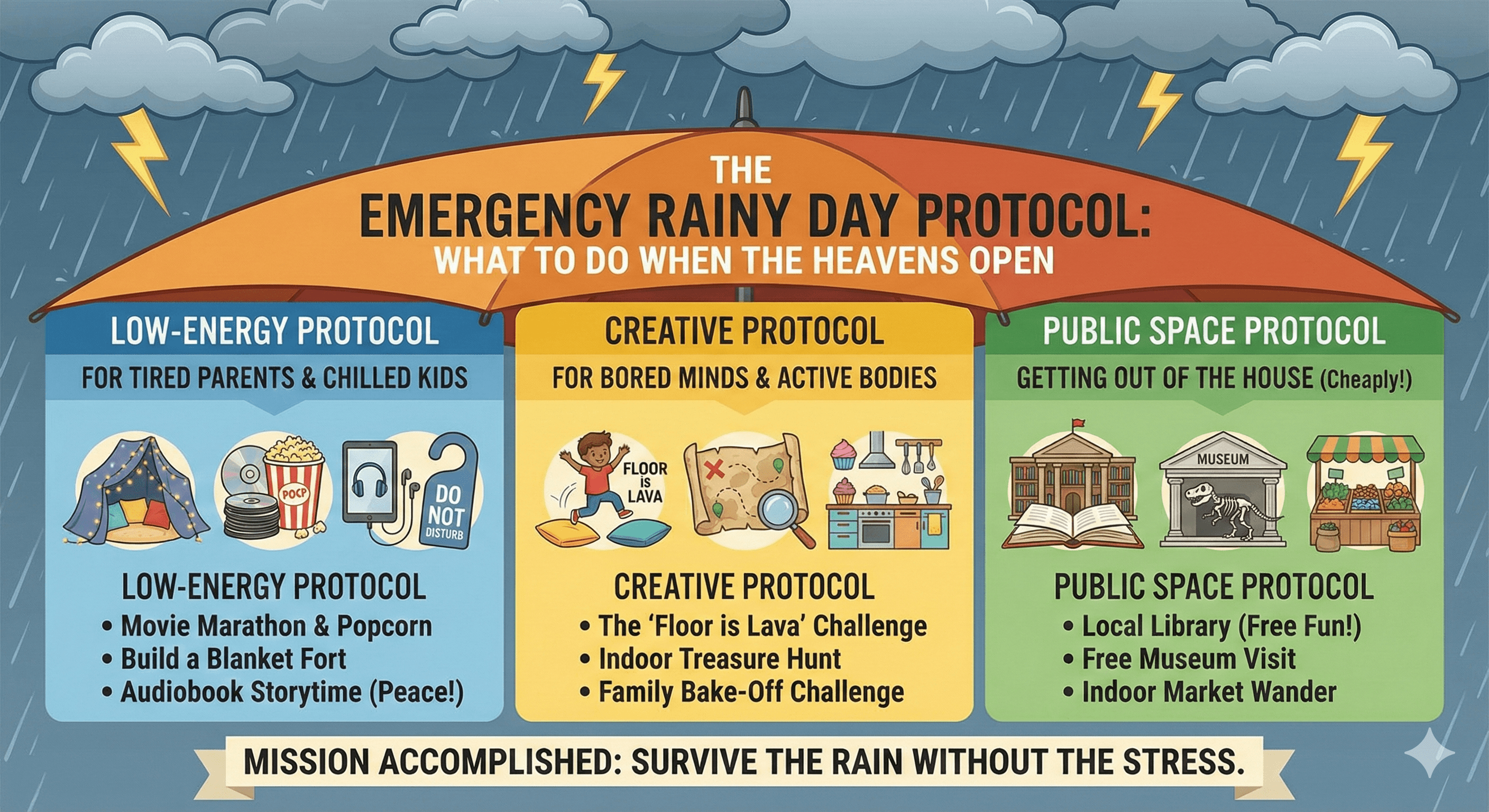
The Emergency Rainy Day Protocol: What to Do When the Heavens Open
It's 9:47am. You're dressed. The kids are dressed. The picnic is packed. And then you look out the window. Here's what to do next.
There's a specific kind of parental despair that only the British weather can deliver.
You've planned a lovely day at the farm park. You've been talking about the goats since Tuesday. Everyone's in wellies. And then the sky turns that particular shade of grey that says: "Not today. Not ever today."
The Met Office said "scattered showers." The Met Office lied.
This is the moment that separates prepared parents from the ones who end up spending £47 on emergency soft play while quietly weeping into a lukewarm cappuccino.
Here's your emergency protocol—a tiered system of rainy day responses, from "light drizzle, we can push through" to "genuine apocalypse, deploy the big guns."
Tier 1: The Light Drizzle Response
Situation: It's raining, but not dramatically. The kind of rain that makes you question whether you're being soft.
The mindset shift: British kids are waterproof. This is a feature, not a bug.
Option 1A: Go Anyway (With Adjustments)
Some outdoor activities are actually better in light rain:
- Woodland walks – Fewer people, the forest smells amazing, and puddles become features not obstacles
- Beaches – Empty. Genuinely empty. Bring hot chocolate in a thermos
- Country parks with good paths – Waterproofs on, boots on, nobody else there
- City walks with covered sections – Museum Mile in London, covered markets in most cities
The gear that makes this work:
- Proper waterproofs (not showerproof—actual waterproof)
- Wellies or waterproof boots
- A change of clothes in the car
- Hot drinks in a thermos
- The willingness to say "we're doing this"
The parenting win: Kids who go out in the rain develop a tolerance for discomfort that serves them forever. You're building resilience. You're also getting them tired, which serves you at bedtime.
Option 1B: The "Covered Outdoor" Pivot
Not quite ready to embrace the drizzle? These options give you fresh air without full weather exposure:
- Garden centres with big covered areas – Surprisingly entertaining for kids. Plants, fish tanks, café with cake
- Covered markets – Borough Market, Leeds Kirkgate, Cardiff Central Market. Interesting, dry, and you can buy lunch
- Shopping centres with outdoor play areas under cover – They exist. Google your local ones
- Sports stadiums with tours – Often mostly indoors, but feels like an "outing"
Tier 2: The Proper Rain Response
Situation: It's genuinely raining. Horizontal rain. The kind where your phone gets wet in your pocket.
The mindset shift: Today is an indoor day. Accept it. Embrace it.
Option 2A: The Library (Seriously)
Libraries are the most underrated half-term resource in Britain. And parents forget they exist.
What modern libraries offer:
- Free. Completely free. No entry charge, no parking charge, no "suggested donation"
- Children's sections with seating, often with toys and puzzles
- Regular half-term events (craft sessions, story time, coding workshops)
- Computers with internet access
- Warmth, toilets, and nobody asking you to buy anything
The upgrade move: Check your local library's half-term programme before the holiday starts. Many run free events that need booking. These fill up fast but are genuinely excellent—author visits, science workshops, LEGO clubs.
Finding this: Search "[your council] library events half term" and you'll find the programme.
Option 2B: The Museum Pivot
We covered free museums in another post, but here's the rainy day angle: museums are designed for weather like this.
The rainy day museum rules:
- Go to the less famous one. The big museums get mobbed when it rains. The smaller local ones stay quiet.
- Arrive just after lunch. Families flee after the morning, before the school-run pickup.
- Don't try to see everything. Pick one gallery. Do it properly.
Museums specifically good for rainy half-terms:
- Transport museums (kids can sit in vehicles, press buttons)
- Natural history museums (dinosaurs never get old)
- Interactive science centres (even the paid ones are cheaper than soft play for a family)
Option 2C: Swimming
The nuclear option for burning energy on a rainy day.
Why swimming works:
- Tires them out completely
- They're already wet, so rain doesn't matter
- Most pools have café areas for recovery afterwards
- Many pools have soft play attached now
The logistics:
- Check "family swim" or "public session" times before you go
- Pack snacks for after (poolside cafés are expensive)
- Bring more towels than you think you need
- Leave two hours. One hour in the pool, one hour for changing chaos
Option 2D: Cinema (The Calculated Splurge)
Sometimes you just need to sit in the dark for two hours while someone else entertains your children.
Making cinema affordable:
- Weekday morning screenings – Often £5-6 per ticket vs £12+ for weekend evenings
- Meerkat Movies – If you have a Comparethemarket policy (even cheap one-day travel insurance counts), you get 2-for-1 cinema every Tuesday/Wednesday
- Kids' clubs – Odeon, Vue, Cineworld all run cheap weekend morning screenings (£2.50-3)
- Vue Mini Mornings – Weekdays during holidays, around £2.50
- Bring your own snacks – Technically frowned upon, universally done
The timing trick: Check what's on before you need it. During half term, cinemas run more family screenings, but the popular ones sell out.
Tier 3: The "Stuck at Home" Protocol
Situation: You're not going anywhere. The car journey isn't worth it. It's raining, everyone's grumpy, and you need to get through the next six hours.
The mindset shift: Home days aren't failures. They're necessary recovery time disguised as weather problems.
The First Rule of Home Days
Structure prevents chaos.
An unstructured rainy day at home descends into screen time and sibling warfare within ninety minutes. A loosely structured day can be genuinely lovely.
The structure doesn't need to be rigid. It just needs to exist.
Sample home day structure:
| Time | Activity |
|---|---|
| 9:00-10:00 | Free play / breakfast recovery |
| 10:00-11:00 | Main activity (see below) |
| 11:00-11:30 | Snack + screen time (earned) |
| 11:30-12:30 | Second activity or outdoor time if rain eases |
| 12:30-1:30 | Lunch + quiet time |
| 1:30-2:30 | Afternoon activity |
| 2:30-3:00 | Snack |
| 3:00-4:00 | Free play / screens |
| 4:00-5:00 | Help with dinner prep (activity in disguise) |
| 5:00 onwards | Normal evening routine |
You don't need to fill every slot with Pinterest-worthy crafts. You just need to have something planned for the bolded slots.
20 Low-Effort Indoor Activities (That Actually Work)
The "No Prep Required" Tier:
-
The Floor is Lava – Clear breakable items, shout "THE FLOOR IS LAVA," watch them leap between cushions for 30 minutes. Zero prep. Maximum energy burn.
-
Blanket Fort – Give them every blanket in the house, some chairs, and a torch. Walk away. They'll be busy for an hour. Serve lunch in the fort for bonus points.
-
Hide and Seek (Extended Edition) – Play properly. Count to 100. Hide in genuinely difficult spots. This version takes longer and is actually fun for adults too.
-
Indoor Treasure Hunt – Write clues on scraps of paper. Hide them around the house. Put chocolate at the end. 15 minutes of prep, 45 minutes of entertainment.
-
Disco – Spotify, living room, lights off, phone torch for disco ball effect. Dance until everyone's sweaty. Call it "exercise."
The "Minimal Prep" Tier:
-
Baking – Cookies, cupcakes, banana bread. The activity is the process, not the result. Expect mess. Factor in cleaning time.
-
Cardboard Box Construction – Save a big delivery box. Give them tape, scissors, markers. They'll make... something. Possibly a rocket, possibly a "dog house," definitely a mess.
-
Painting – Poster paints, newspaper on the table, old t-shirts as smocks. Let them paint whatever they want. Frame the best one.
-
Playdough (Homemade) – 1 cup flour, ½ cup salt, 2 tbsp cream of tartar, 1 cup water, 1 tbsp oil, food colouring. Cook on low heat, stir until it forms a ball. Lasts weeks in a sealed container.
-
Science Experiments – YouTube "easy kids science experiments" and pick one. Baking soda and vinegar volcanoes. Milk and food colouring. Stuff that fizzes.
The "Actually Educational But Don't Tell Them" Tier:
-
Cooking Lunch Together – Give them actual jobs. Washing vegetables, stirring, laying the table. Takes longer, but fills time and teaches skills.
-
Letter/Postcard Writing – Grandparents love this. Kids practise handwriting. Everyone wins. Walk to the postbox when the rain eases.
-
Board Games – But actually playing them, not just suggesting them. Classics: Uno, Dobble, Guess Who, Connect 4. 30+ minutes each.
-
Jigsaw Puzzles – Get one out. Leave it on the table. Work on it throughout the day. Surprisingly absorbing for all ages.
-
Sorting/Organising – "Can you organise your bookshelf by colour?" "Can you sort your LEGOs by type?" They find this weirdly satisfying.
The "When You're Desperate" Tier:
-
Bath in the Middle of the Day – Run a bubble bath at 2pm. Add toys. Maybe add food colouring (it washes off). They think it's transgressive. You get 30 minutes of peace.
-
Movie Marathon with Theme – Not just "watching TV" but a curated experience. Pick a theme (Pixar afternoon, Studio Ghibli day, all the Spider-Mans). Make popcorn. Close curtains. Lean in.
-
Video Call Bingo – Call a grandparent or cousin. Play bingo together, show and tell, or just chat. Social interaction that doesn't require leaving the house.
-
Audiobook + Activity – Put on an audiobook (Roald Dahl, David Walliams, whatever they like) while they do LEGO, colouring, or playdough. Screens-off entertainment.
-
The "Yes Day" Hour – For one hour, say yes to (safe, reasonable) requests. Ice cream before lunch? Sure. Eating on the floor? Fine. Wearing pyjamas all day? Obviously. Sets boundaries by having a defined end time.
The Emergency Kit: What to Have Ready
Don't wait until the rainy day hits. Build your emergency kit now.
The Physical Box (Keep Somewhere Accessible):
- A jigsaw puzzle you haven't opened yet
- Colouring books and fresh crayons/pencils
- A pack of modelling clay or playdough
- A simple craft kit (pompoms, pipe cleaners, googly eyes, glue stick)
- A board game or card game
- Sticker books or activity books
The Digital Backup:
- A saved list of YouTube videos you've pre-approved
- Downloaded Netflix/Disney+ content (download before you need it)
- Bookmarked links to printable activities (colouring pages, mazes, dot-to-dots)
- A playlist of kids' music for spontaneous disco
The Cupboard Supplies:
- Basic baking ingredients that don't go off (flour, sugar, vanilla)
- Poster paints and cheap brushes
- Newspaper for covering surfaces
- Old t-shirts for painting smocks
The Permission Slip
Here's something nobody tells you:
Not every day needs to be enriching, educational, or memorable.
Some days, survival is the goal. If everyone's fed, safe, and reasonably content by 7pm, you've won. The bar for a rainy half-term day at home is not "created lasting memories"—it's "got through it without anyone crying, including me."
Screen time on a rainy day when you're trapped inside is not a parenting failure. It's a tool, used appropriately.
Beans on toast for lunch is fine.
Staying in pyjamas until 11am is fine.
Not leaving the house all day is fine.
The only rule is: tomorrow, try again.
Let Us Handle the Backup Plans
When you use the School Holiday Planner, every single day comes with a built-in backup activity.
Main plan: farm park. Backup: science museum. Main plan: beach. Backup: local soft play. Main plan: nature walk. Backup: library craft session.
You don't have to think of alternatives at 9:47am with everyone in wellies watching the sky fall. We've already done it for you.
Generate your backup-ready plan
What's your go-to rainy day survival tactic? Share your best tips—we're always looking for ideas that actually work in the real world of parenting.