How to Plan a Day Out That Both a Teenager AND a Toddler Will Enjoy
The 3-year-old wants to feed ducks. The 14-year-old would rather die. Here's how to plan a day that doesn't end in mutiny.
There's a special circle of parenting hell reserved for those of us with kids at opposite ends of the age spectrum.
The toddler wants stimulation. The teenager wants to be left alone. The toddler has the attention span of a caffeinated goldfish. The teenager has the enthusiasm of a depressed sloth. The toddler wants to go NOW. The teenager won't be ready until 11:47am at the earliest.
And you—you just want everyone to have an okay time. Not even a great time. Just... okay. Minimal complaining. No one crying. Perhaps even, if the stars align, a moment where everyone seems vaguely content at the same time.
This is the guide for that. Not perfection—survival.
The Fundamental Problem (And Why Most Days Out Fail)
Here's why family days out with big age gaps usually go wrong:
The toddler-optimised day:
- Soft play, farm park, playground
- Early start (they're up at 6am anyway)
- Nap-friendly schedule
- Everything is loud, sticky, and primary-coloured
The teenager-optimised day:
- Lie-in until noon
- Something "cool" (not baby stuff)
- Good food
- Phone access
- Definitely nothing that requires wearing wellies
The attempted compromise:
- Farm park that "has something for everyone"
- Reality: Toddler loves it. Teenager stares at phone in café for three hours
- Everyone leaves drained
The problem isn't the destination. It's the assumption that one activity can satisfy both.
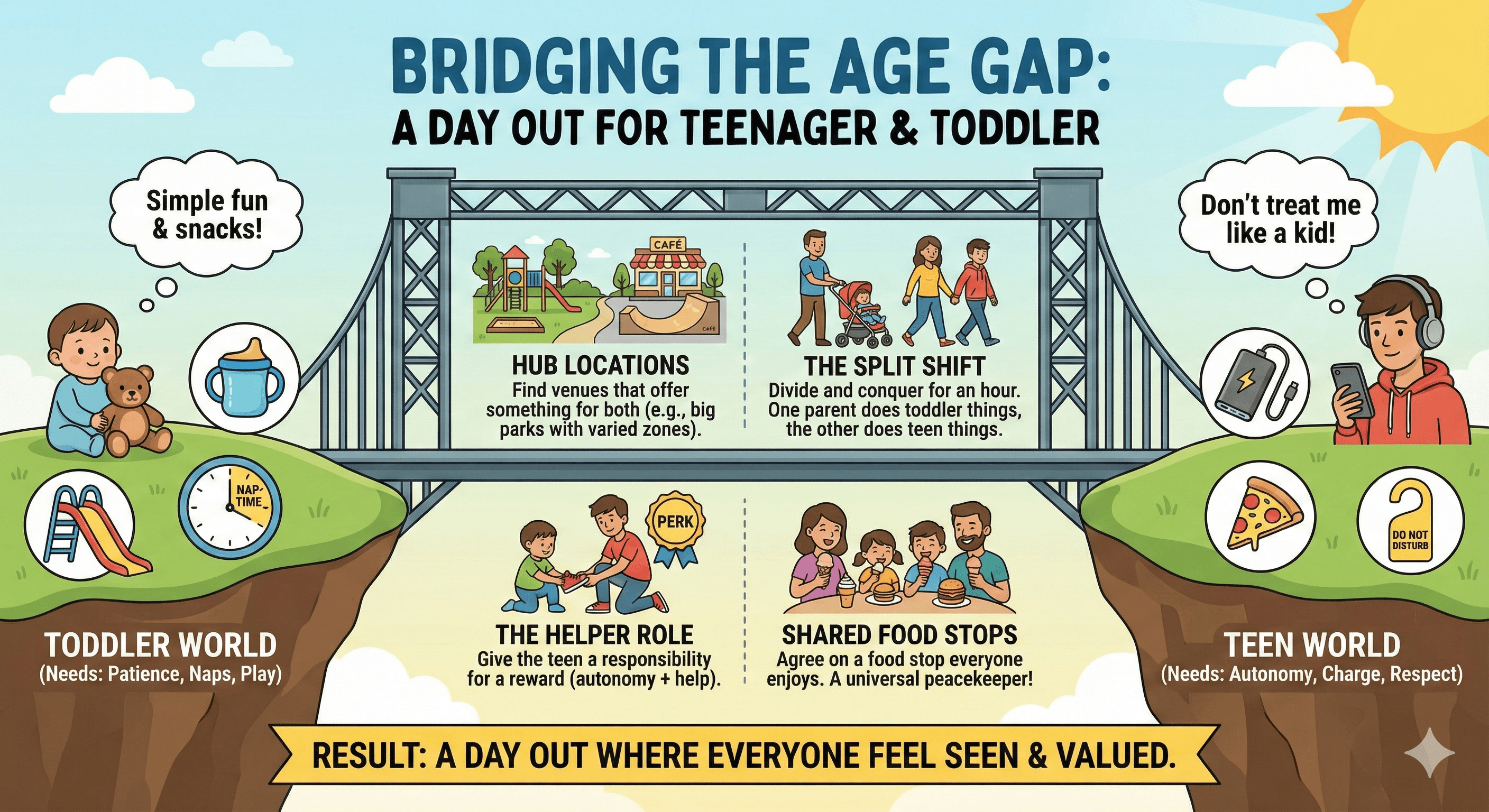
Strategy 1: The "Hub and Spoke" Approach
The concept: Choose a destination that works as a base, then let different family members do different things.
The ideal hub characteristics:
- Multiple distinct areas or activities
- Good café/seating area (teenager base camp)
- Activities that can be done independently
- Easy to regroup
Hub Examples That Actually Work
Big country parks with cafés:
- Toddler goes to playground with one parent
- Teenager sits in café with phone and a toastie, or does a longer walk
- Regroup for lunch
- Swap: toddler comes to café for snack, teenager explores with other parent
Shopping centres with multiple zones:
- Teenager gets to browse shops they like
- Toddler goes to the play area or family-friendly bit
- Meet for food court lunch
- Nobody feels like they're doing "the other person's thing" all day
Beach/seaside towns:
- Toddler builds sandcastles with one parent
- Teenager explores town, goes to arcade, gets ice cream independently
- Regroup for fish and chips
- Everyone's had some of what they wanted
Big museums:
- You don't have to stay together
- Toddler does the interactive gallery with one parent
- Teenager does the gallery they're actually interested in
- Meet at the café
The key insight: You don't all have to do the same thing at the same time. You just need to be in the same place.
Strategy 2: The "Turn-Taking" Day
The concept: Explicitly structure the day so everyone gets "their" bit. Fair, transparent, and weirdly effective.
How it works:
- Morning: Teenager's choice
- Afternoon: Toddler's choice
- Or vice versa
Why this works:
- Nobody can complain about fairness (the deal is clear)
- Each child genuinely gets something they want
- The one who's "not their turn" often copes better than expected, because they know their turn is coming
Making Turn-Taking Work
For the teenager during the "toddler" activity:
- Explicit permission to use phone/earbuds
- Café privileges (buy them a fancy coffee, let them sit out)
- Lower expectations ("you don't have to pretend to love the petting zoo—you just have to not ruin it for your sister")
- Genuine appreciation when they engage
For the toddler during the "teenager" activity:
- Snacks (the universal pacifier)
- Buggy/carrier as needed (they can nap through the boring bit)
- Lower expectations (they probably won't remember)
- Find small wins (the toddler might actually enjoy the arcade more than expected)
Sample turn-taking day:
| Time | Activity | Who It's For |
|---|---|---|
| 10:00-12:00 | Trampoline park / bowling / escape room | Teenager |
| 12:00-1:00 | Lunch (somewhere with a kids' menu AND decent food) | Everyone |
| 1:00-3:00 | Playground / soft play / farm park | Toddler |
| 3:00-3:30 | Ice cream | Everyone |
| 3:30 onwards | Home or easy neutral activity | Everyone (ideally napping) |
Strategy 3: The "Teenager as Helper" Reframe
The concept: Instead of treating the teenager as another child to entertain, treat them as a junior adult who's helping with the toddler.
Why this sometimes works:
- Teenagers often respond well to responsibility
- Gives them a defined role that isn't "sulking"
- Toddlers often idolise older siblings
- Can actually be helpful for the parents
How to pitch it:
- "Can you take [toddler] on that ride? I'll get coffees and you can have twenty minutes on your phone after"
- "You're so good with them—they really look up to you"
- "Help me tire them out in the playground and we can go somewhere you want after"
The important caveats:
- This only works if the teenager is willing
- Don't overdo it (they're not a free babysitter)
- Reward the help genuinely
- Some teenagers hate this—read your kid
The Payment Model
Some families make this explicit:
- "Help with your sister this morning = extra pocket money / screen time / choice of dinner"
- Not bribery—payment for work
- Teenagers understand transactions
Strategy 4: Venues That Genuinely Bridge the Gap
Some places are just built for wide age ranges. These aren't compromises—they're genuinely good for everyone.
The Tier 1: Actually Work for Both
Beaches:
- Toddlers: Sandcastles, paddling, running
- Teenagers: Swimming, exploring, lying around looking at phone
- Why it works: Space. Everyone can do their own thing in the same place. Doesn't feel like a "little kid" or "big kid" activity.
Big outdoor adventure centres (Go Ape, Zip World, etc.):
- Often have specific courses for different ages
- Toddler does the "Treetop Toddler" version
- Teenager does the high ropes
- Different difficulty, same location
- Check: Some have minimum ages—verify before booking
National Trust / country estates:
- Toddler: Playground, nature trail, stick collecting
- Teenager: Actually quite nice grounds to walk around, decent café, photo opportunities
- Why it works: Teenagers can frame this as "aesthetic" rather than babyish
City exploration days:
- Not a single activity—a walking day with multiple stops
- Coffee shops, bookshops, cool spots for the teenager
- Playgrounds, pigeons, ice cream for the toddler
- Lunch somewhere good
Aquariums / Sea Life centres:
- Dark, atmospheric, interesting
- Teenagers can engage at their level (ecology, conservation)
- Toddlers just like fish
- Nobody feels like it's "for babies"
Tier 2: Work Better Than Expected
Bowling:
- Bumpers for the toddler
- Genuinely competitive for the teenager
- Arcade games after
- Food on site
- 90 minutes, everyone occupied
Mini golf:
- Toddler whacks ball around chaotically
- Teenager can actually try to play
- Usually has ice cream
- Takes an hour or so—good as part of a bigger day
Cinema:
- If the film's right, this works
- Animated Pixar-type films can genuinely appeal to both
- Toddler might not last the whole film—be ready to leave
- Teenager gets popcorn and darkness
Escape rooms (some):
- Specifically family-friendly ones with lower age limits
- Teenager leads, toddler presses buttons
- Check age recommendations carefully
Tier 3: The Sleeper Hits
Ice skating:
- Toddlers on those penguin stabilisers = adorable
- Teenagers can actually skate (or try to)
- Café for watching
- Seasonal, but excellent
Pottery painting cafés:
- Sounds crafty, but teenagers often get into it
- Toddlers bash paint on a mug
- Everyone sits together
- Take home a souvenir
Theatre / pantomime:
- Good pantos genuinely entertain all ages
- Jokes for adults, slapstick for toddlers, spectacle for teenagers
- Book seats on the aisle for emergency exits
The Practical Logistics
Timing
The teenager's body clock:
- Wakes: Never voluntarily before 10am
- Peak functioning: 11am-9pm
- Will claim to be "tired" at 10am and wired at 11pm
The toddler's body clock:
- Wakes: 6am (or earlier, for spite)
- Peak functioning: 8am-11am, 3pm-5pm
- Meltdown windows: 11:30am and 5:30pm
The overlap window: Late morning to early afternoon is your best shot.
Sample realistic schedule:
- 9:00am: Toddler breakfast, teenager slowly wakes
- 10:30am: Leave house (teenager just about functional)
- 11:00am: Arrive at destination
- 11:00am-1:00pm: Main activity
- 1:00pm: Lunch
- 2:00pm-3:30pm: Second activity or wind down
- 3:30pm: Leave (before toddler meltdown, before teenager gets hungry again)
Food
The food requirements are almost completely incompatible:
Toddler: Needs to eat at precisely 12:07pm or will disintegrate. Requires foods cut into specific shapes. Drops 40% of everything on floor.
Teenager: Would prefer not to eat at a "family restaurant." Wants something "good." Will eat three times their body weight if allowed.
The solution:
- Accept you're eating at "family-friendly" places (the teenager can cope)
- BUT choose ones with decent food, not just a kids' menu
- Pubs with proper food often work better than chain restaurants
- If the teenager's being good, let them order from the adult menu
- Food courts let everyone get something different
Transport
If the toddler still naps:
- Time drives for nap time
- Bring the buggy even if you think you won't need it
- A sleeping toddler = peace for everyone
If you're using public transport:
- The teenager is mortified by the buggy on the train
- Too bad
- They can help carry it, or they can get over it
The Phone Question
The reality: The teenager is going to be on their phone. At least some of the day. Probably a lot of the day.
The progressive approach:
- Accept some phone time, especially during "not their turn" activities
- Negotiate limits: "I'd like you to put it away for lunch and when we're all doing something together"
- No phones for safety stuff (climbing, swimming, crossing roads)
- Genuine activity for them = less phone time naturally
The hard line (if needed):
- "Phone away during [specific activity], then you can have it back"
- Follow through
- Pick your battles—it's not worth fighting over phone use in the café
Setting Realistic Expectations
For the Teenager
Before the day, be honest:
- "Some of today is going to be boring for you. I know that."
- "We're going to do [toddler activity] for about two hours. You can bring your headphones."
- "In exchange, we'll [do something they want] / [give them some independence] / [buy them something nice for lunch]"
The acknowledgment that you know it's not all for them goes a long way.
For Yourself
Expect:
- At least one complaint
- At least one "this is boring"
- At least one toddler meltdown
- At least one moment where you question all your choices
Also expect:
- Moments that work
- Maybe a photo where everyone's smiling
- The teenager actually helping without being asked (occasionally)
- Getting through it
The Age-Gap Planner
This is exactly the problem our tool is designed to solve.
When you tell the School Holiday Planner your children's ages—say, 3 and 14—it specifically searches for:
- Venues suitable for both ages
- Activities with different levels of engagement
- Days that can be structured for turn-taking
- Backup options that work across the age range
We don't suggest soft play for your teenager or laser tag for your toddler. We find the sweet spots.
Enter your kids' ages and see what we find
What's your best tip for surviving family days out with a big age gap? Let us know—we're always looking for real-world strategies that work.