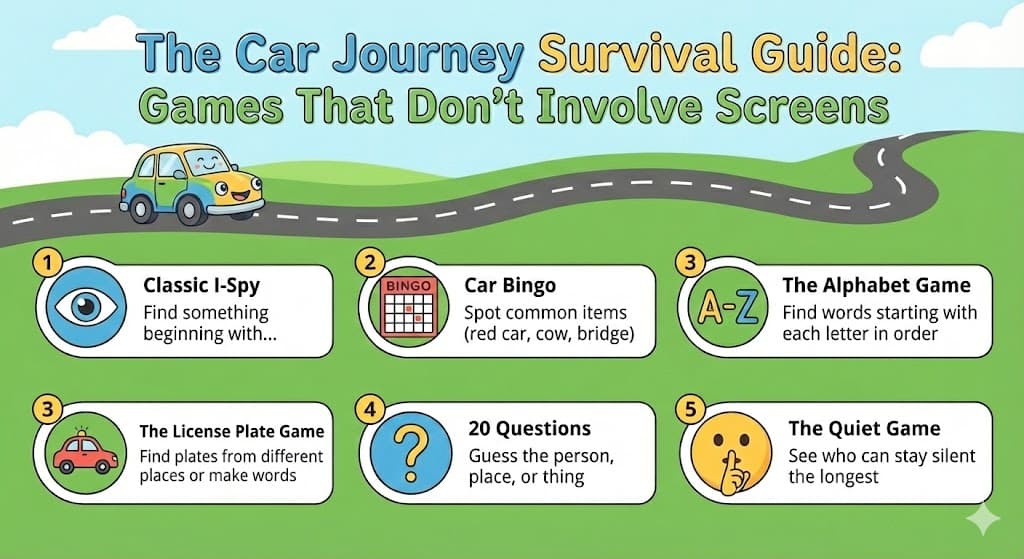
The Car Journey Survival Guide: Games That Don't Involve Screens
"Are we there yet?" No. But here are 47 ways to make the next hour bearable—without anyone throwing up or throwing punches.
There's a specific kind of optimism that possesses parents before a long car journey.
"It'll be fine," you think. "We'll play games. We'll chat. It'll be quality family time."
Forty-five minutes later, someone's crying, someone else is kicking the seat, the toddler has dropped their snack into an unreachable crevice, and you're seriously considering whether you can legally leave children at a service station.
The problem isn't the journey. It's the lack of a plan for the journey.
This is that plan: a comprehensive arsenal of screen-free car games, organised by age, energy level, and desperation. Plus the stuff nobody tells you about motion sickness, sibling warfare, and why timing matters more than entertainment.
Part 1: The Motion Sickness Rules
Before we get to games, let's address the thing that ruins car journeys faster than anything else: vomit.
Motion sickness affects roughly 1 in 3 children (and plenty of adults). Even kids who don't usually get sick can succumb on winding roads, in hot cars, or when they're tired.
The golden rules:
What Makes It Worse
- Looking down – Reading, colouring, screens, anything that focuses eyes on something inside the car
- Sitting in the back middle seat – Worst view, most motion
- Hot, stuffy air – Keep the car cool and ventilated
- Strong smells – Air fresheners, food, fuel
- Empty stomachs – Counterintuitively, hunger makes nausea worse
- Full stomachs – But so does a huge meal right before travel
What Makes It Better
- Looking at the horizon – Eyes on distant, stable points
- Fresh air – Windows cracked, air con on
- Front seat (if age-appropriate) – Better view, less motion sensation
- Frequent breaks – Every 90 minutes minimum
- Ginger – Ginger biscuits, ginger ale, crystallised ginger
- Wristbands – Sea-Bands work for some kids
- Timing – Travel during nap time when possible
The Practical Implication for Games
This means: no games that require looking down.
No colouring books. No card games. No activity books. No "find the hidden picture" puzzles.
Every game in this guide is eyes-up, looking-out-the-window, or imagination-based. They're not just screen-free—they're sick-bag-free.
Part 2: The Sibling Warfare Prevention Protocol
The other journey-killer: fighting.
Siblings in close proximity, strapped in, unable to escape each other, bored—it's basically a laboratory for conflict.
Structural solutions:
The Physical Setup
- Middle seat stays empty – If you have two kids and three back seats, put one behind each front seat. The gap prevents poking, kicking, and "they're looking at me"
- Clear territory – Each child has their own footwell, their own window, their own snack bag
- Headphones available – Even without screens, audiobooks and music through individual headphones create personal space
The Psychological Setup
- Team games, not competitive games – Games where siblings work together cause less friction than games where they compete
- Turn-taking structures – "Whoever spots it first" games cause arguments. "It's your turn to look" games don't
- Separate activities available – Sometimes the answer is "you do your thing, they do their thing, no interaction required"
The Intervention Protocol
When fighting starts despite your best efforts:
- One warning – "If this continues, we're pulling over and sitting in a lay-by until everyone's calm"
- Follow through – Actually pull over. Actually sit there. It only takes once
- Separate activities – Fighting kids get headphones and no shared games for 30 minutes
- Strategic snacks – Hungry kids fight more. Sometimes the argument is actually about blood sugar
Part 3: The Games Arsenal
Organised by category, with age recommendations and energy levels. Pick based on your current situation.
Category 1: Classic Road Trip Games (All Ages)
These have survived generations for a reason. They work.
I Spy
- Ages: 4+
- Energy: Low
- How: "I spy with my little eye, something beginning with..."
- Pro tip: For younger kids, use colours instead of letters ("something green")
- Variation: "I spy something you can only see for a moment" forces everyone to look out the window
20 Questions
- Ages: 6+
- Energy: Low-Medium
- How: One person thinks of something. Others ask yes/no questions to guess it
- Pro tip: Set categories for younger kids (animals, food, people we know)
- Variation: "Celebrity 20 Questions" for older kids—they think of a famous person
The Alphabet Game
- Ages: 5+
- Energy: Medium
- How: Spot things outside starting with A, then B, then C...
- Pro tip: Work as a team rather than competing—less fighting
- Variation: Use road signs only, or licence plates only
The Number Plate Game
- Ages: 7+
- Energy: Low
- How: Make words or phrases from the letters on number plates (BD51 XKF = "Big Dogs Exercise Kilted Frogs")
- Pro tip: Sillier is better. Award points for making everyone laugh
Pub Cricket
- Ages: 6+
- Energy: Low
- How: One team takes the left side of the road, one takes the right. Count the "legs" on pub signs (The White Horse = 4 legs, The Three Crowns = 0 legs). First to 50 wins
- Pro tip: Explain what counts as legs before you start (birds? people?)
- Works best: On A-roads and through villages. Motorways have no pubs
Category 2: Imagination Games (Ages 5+)
No equipment, no looking down, pure creativity.
The Story Game
- Energy: Medium
- How: One person starts a story with one sentence. Next person adds a sentence. Continue around the car
- Pro tip: Add a rule—every third sentence must include something you can see out the window
- Variation: "Fortunately/Unfortunately"—alternate between good and bad things happening to the character
Would You Rather?
- Energy: Low-Medium
- How: Pose impossible choices. "Would you rather have a tail or wings?"
- Pro tip: Let kids ask the questions—their choices are often more creative than yours
- Variation: Make them holiday-themed ("Would you rather go to the beach every day or the mountains every day?")
Two Truths and a Lie
- Energy: Low
- How: Each person says three things about themselves—two true, one false. Others guess the lie
- Pro tip: Works surprisingly well for learning new things about your own kids
- Best for: Longer journeys where you've exhausted other options
The "What If?" Game
- Energy: Low-Medium
- How: Ask hypothetical questions and discuss answers. "What if animals could talk—which animal would be the rudest?"
- Pro tip: Resist the urge to make it educational. Silly is better
- Examples: "What if you woke up invisible?" "What if it rained sweets?" "What if grown-ups had to go to school?"
The Radio Game
- Energy: Medium
- How: Turn on the radio. First person to correctly predict the next word in the song wins a point
- Pro tip: Use stations that play well-known songs
- Variation: Instead of predicting, make up alternative lyrics
Category 3: Observation Games (All Ages, Window-Focused)
These keep eyes up and looking out—perfect for motion sickness prevention.
Car Bingo
- Ages: 4+
- Energy: Medium
- How: Before the journey, call out 10 things to spot (red car, lorry, bridge, cow, church, etc.). First to spot all 10 wins
- Pro tip: Adjust difficulty by age—easy items for young kids, rare items for older ones
- Variation: Print bingo cards before you go, or just remember a verbal list
Colour Car Count
- Ages: 3+
- Energy: Low
- How: Each person picks a colour. Count how many cars of your colour you see in 5 minutes
- Pro tip: Let the youngest pick first (they always want red, and red is common)
- Variation: Count lorries, motorbikes, or caravans instead
Yellow Car
- Ages: 4+
- Energy: Medium-High
- How: Spot yellow cars. Shout "yellow car!" when you see one. Different families have different rules about what happens next
- Warning: This game can get loud and competitive. Set ground rules
- Variation: Some families play that you get to gently punch your sibling (we don't recommend this)
The Quiet Game (Observation Edition)
- Ages: 5+
- Energy: Low (very low)
- How: Everyone stays silent until they spot something from a predetermined list (police car, horse, person waving, etc.)
- Pro tip: Yes, this is partly a trick to get silence. It still counts as a game
- Duration: Usually 5-10 minutes before someone cracks
Motorway Bingo
- Ages: 6+
- Energy: Low
- How: Specific to motorway journeys—spot: Eddie Stobart lorry, caravan, foreign number plate, broken-down car, police car, motorbike with sidecar, horse box...
- Pro tip: Make an actual list of 20 items, tick them off as you go, see how many you get before your destination
Category 4: Music and Rhythm Games (All Ages)
Good for energy release and group bonding.
Name That Tune
- Ages: 4+
- Energy: Medium
- How: Hum or "la la la" a song. Others guess what it is
- Pro tip: Use songs everyone knows—theme tunes work well
- Variation: Tap the rhythm on the dashboard instead of humming
The Singing Game
- Ages: 5+
- Energy: Medium-High
- How: One person sings a line from a song. The next person must sing a line from a different song that starts with the last word (or a word in the last line) of the previous song
- Pro tip: Allow "passes" for younger kids
- Example: "Let it go, let it go..." → "Go Johnny go, go go..."
Finish the Lyric
- Ages: 6+
- Energy: Medium
- How: Sing a song and stop suddenly. The next person has to sing the next line
- Pro tip: Use songs from movies everyone's seen
- Variation: Get it wrong on purpose—kids love correcting parents
The Rhythm Game
- Ages: 4+
- Energy: Low-Medium
- How: One person claps a rhythm. Everyone else copies. Make it progressively harder
- Pro tip: Let kids take turns being the rhythm leader
- Variation: Add sounds—claps, clicks, thigh slaps
Category 5: Word Games (Ages 7+)
For older kids and longer journeys when you want something more challenging.
The Minister's Cat
- Ages: 7+
- Energy: Low
- How: "The minister's cat is an ANGRY cat" → "The minister's cat is a BASHFUL cat" → through the alphabet
- Pro tip: Add a rhythm—clap between each turn to keep pace
- Variation: Use other categories (adjectives about animals, types of food, etc.)
Word Association
- Ages: 6+
- Energy: Low
- How: One person says a word. Next person says the first word that comes to mind. Continue
- Pro tip: Speed makes it harder and funnier
- Variation: "Opposite word"—say the opposite of the previous word
Ghost
- Ages: 9+
- Energy: Low
- How: Players take turns adding letters to build towards a word without completing it. If you complete a word, you lose. If you add a letter that can't lead to a real word, you can be challenged
- Pro tip: This is surprisingly addictive for older kids
- Example: A → AT → ATT → ATTE... (trying to make "attention" without finishing a shorter word)
The Category Game (Scattergories style)
- Ages: 8+
- Energy: Low-Medium
- How: Pick a category (countries, foods, animals). Pick a letter. Take turns naming things in that category starting with that letter until someone can't
- Pro tip: Allow challenges if someone names something questionable
- Variation: One person picks category, another picks letter—prevents gaming the system
Hypothetical Headlines
- Ages: 10+
- Energy: Medium
- How: Create fake newspaper headlines about your journey. "Local family survives three-hour journey with only one service station stop"
- Pro tip: Award points for creativity, silliness, or accuracy
- Best for: Older kids with good senses of humour
Category 6: Physical Games (Without Leaving the Car)
For when energy needs releasing but you can't stop.
Hand Slaps (Cooperative Edition)
- Ages: 6+
- Energy: Medium
- How: Stack hands on top of each other (works between front seat passenger and back seat child). Bottom hand slaps to the top. Build speed
- Pro tip: This is about coordination, not violence. Keep it gentle
- Caution: Not for the driver
Thumb Wrestling
- Ages: 5+
- Energy: Medium
- How: Classic thumb wrestling, works between adjacent passengers
- Pro tip: Tournament brackets for longer journeys
- Caution: Keep it friendly—this can escalate
The Copying Game
- Ages: 3+
- Energy: Medium
- How: One person makes a gesture or movement (within seatbelt constraints). Others copy exactly
- Pro tip: Let the youngest lead—they love having power
- Variation: Add sounds to make it harder
Part 4: The Journey Structure
Games alone don't save a journey. Structure does.
The 90-Minute Rule
Most children (and adults) need a break every 90 minutes maximum. This isn't optional—it's biological. Build stops into your journey plan, not as emergencies but as scheduled events.
Sample 3-Hour Journey Structure:
| Time | Activity |
|---|---|
| 0-15 mins | Settling in, snack distribution, choosing first game |
| 15-45 mins | Active game (I Spy, Colour Car Count) |
| 45-60 mins | Quieter game (Story Game, Would You Rather) |
| 60-75 mins | Audiobook/music break |
| 75-90 mins | Stretch stop (service station, lay-by, anywhere with toilets) |
| 90-105 mins | Active game (new one, not repeat) |
| 105-120 mins | Independent quiet time (looking out window, resting) |
| 120-150 mins | Word games or conversation |
| 150-180 mins | Final push, snacks, "nearly there" energy |
The Key Principles:
- Alternate energy levels – High energy game → low energy game → break
- Don't repeat games – Even good games get stale. Move on
- Have more games than you need – You won't use them all, but you need options
- Build in "nothing" time – Some minutes should just be quiet looking out the window
- Save a "trump card" – One special game or treat for the final desperate stretch
Part 5: The Emergency Toolkit
Keep these in the car for journey emergencies:
The Physical Kit:
- Sick bags (dog poo bags work, weirdly)
- Wet wipes
- Kitchen roll
- Change of clothes for each child (in sealed bag)
- Empty carrier bags for rubbish
- Blanket (for cold, or for covering sick child)
- Sunshade for windows
The Snack Kit:
- Dry, non-crumbly snacks (raisins, crackers)
- No chocolate (melts, mess)
- No oranges (smell can trigger sickness)
- Ginger biscuits (help with nausea)
- Water (not juice—less sticky when spilled)
The Entertainment Backup:
- Audiobook downloaded and ready
- Playlist everyone agreed on before departure
- One physical item per child (small toy, book for when car is stationary)
The Journey Is Part of the Day
Here's a mindset shift worth making:
The car journey isn't dead time between home and fun. It's part of the day out.
When you plan it properly—games ready, stops scheduled, snacks packed—the journey becomes something the kids look forward to, not endure.
Some of our best family conversations happen in the car. Some of our silliest games. Some of our most unexpected bonding.
The key is treating it as part of the plan, not an obstacle to the plan.
Let Us Plan the Destination
You handle the journey. We'll handle where you're going.
The School Holiday Planner generates day-by-day itineraries based on your location, your kids' ages, and your budget. We'll tell you what to do when you get there—including how long it takes, whether you need to book, and what the backup is if plans change.
You arrive knowing exactly what the day holds.
Got a favourite car game we've missed? Let us know—we're always adding to the arsenal.